What Are the Key Signs That an Industrial Hose Needs Replacement?
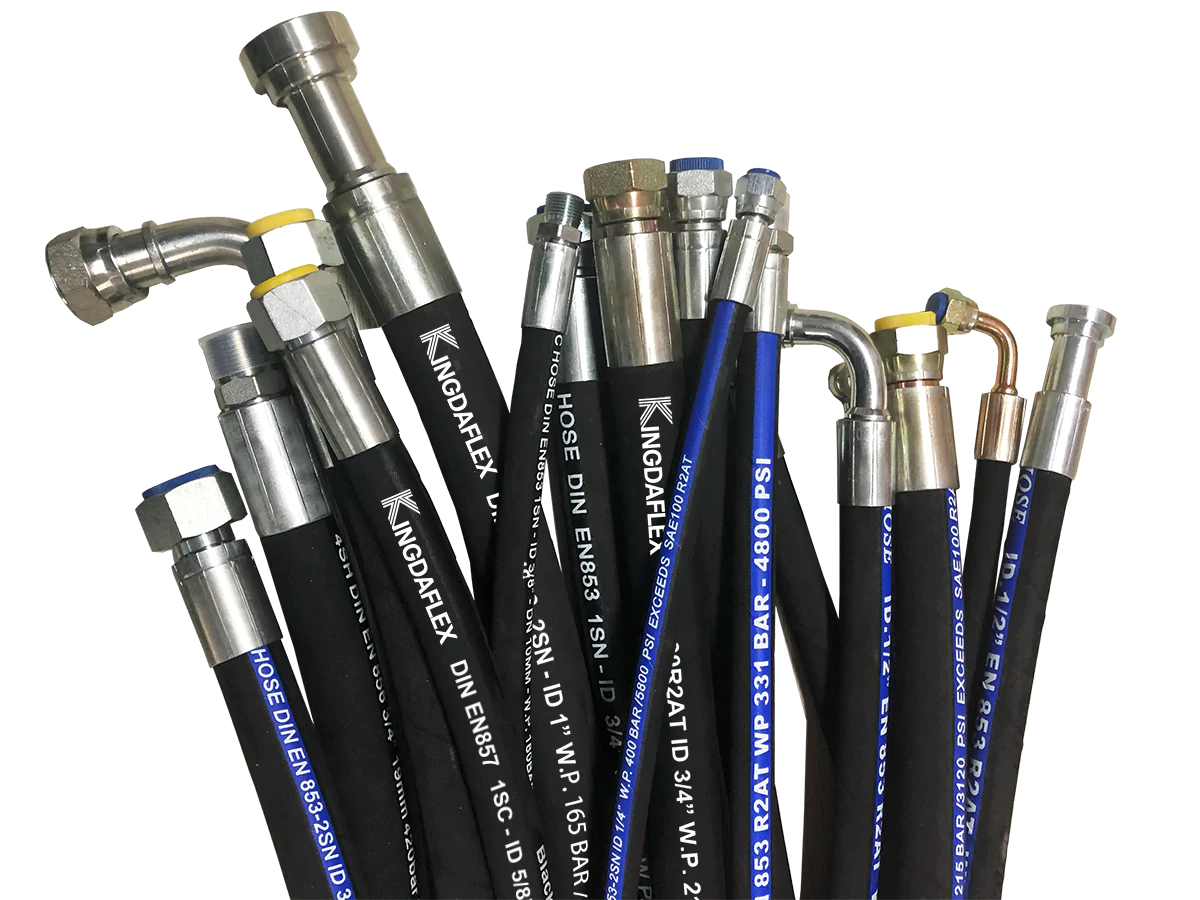
An industrial hose should be replaced when inspection finds deep abrasion, exposed reinforcement, cover cracking, bulges, soft spots, leaks, coupling movement, permanent kinks, crushing, heat damage, chemical swelling, or unusual stiffness. Parker’s industrial hose safety guidance lists damaged covers, exposed reinforcement, fitting slippage, leaks, twisted hose, and blistered or degraded covers as conditions requiring shutdown and replacement. Pressure testing can add another check: Gates specifies hydrostatic testing at 150% of rated working pressure for five minutes for certain industrial hose assemblies. Age alone is not enough; replacement intervals should also reflect pressure, temperature, media, movement, abrasion, inspection history, and the consequences of failure.
A worn outer cover is usually the easiest defect to find. Light scuffing may affect only the surface, but a cut that reaches textile braid or steel-wire reinforcement has moved beyond cosmetic wear. Parker’s guidance calls for replacement when abrasion, cracking, or cutting exposes reinforcement. In a hose operating at 150 psi, 300 psi, or substantially higher pressure, the reinforcement—not the outer rubber—is carrying much of the pressure-related stress.
That makes the depth and location of wear more useful than the percentage of the cover that looks damaged. A 20 mm worn patch over a reinforcement layer may deserve more attention than several meters of shallow surface rubbing, particularly near clamps, floor-contact points, reel guides, or machine edges where the same area bends during every operating cycle.
Once reinforcement becomes visible, replacing the assembly is normally more appropriate than covering the damaged area with tape or a sleeve. An external covering cannot restore reinforcement that has been cut, corroded, or mechanically weakened.
Bulges and blisters require a different type of inspection because the problem may be developing within the hose wall. Reinforced hose is built from several bonded layers; if the tube, reinforcement, or cover separates locally, pressure can push the weakened area outward. Even a bulge covering less than 5% of the hose length can be more serious than uniform surface aging because deformation is concentrated in one section.
Soft spots deserve similar treatment. Contact with an incompatible fluid can change elastomer properties, while excessive temperature can harden one compound and soften another. ISO 8331:2016, the fourth edition of the international guidance covering hose selection, storage, use, and maintenance, treats preservation of hose condition throughout service as part of hose management rather than relying only on visible leakage.
| Inspection finding | What it may indicate | Maintenance response |
|---|---|---|
| Local bulge or blister | Layer separation or reinforcement damage | Remove from service and inspect |
| Soft, swollen cover | Chemical or thermal deterioration | Check media and temperature compatibility |
| Hard, cracked surface | Heat exposure or aging | Replace if cracking or stiffness is significant |
| Exposed braid or wire | Cover worn through | Replace the assembly |
| Coupling movement | Loss of hose-to-fitting retention | Remove from pressure service |
Leaks provide a more measurable warning. A pinhole that releases only a few milliliters of fluid during a short observation period may still be connected to a much larger pressure problem; Parker specifically warns that very small holes can release narrow, difficult-to-see streams of pressurized hydraulic fluid. Inspection by hand is therefore a poor practice around a suspected high-pressure leak.
Coupling areas need even closer observation because bending forces often concentrate near the fitting. A hose that repeatedly bends within the first 50–100 mm behind a coupling can experience localized fatigue sooner than the middle of the assembly. Any measurable coupling movement, exposed hose material behind a ferrule, leaking threads, corrosion, or hose pull-out should be compared with the assembly maker’s acceptance criteria.
Gates recommends checking industrial hose assemblies for cuts, abrasion, bulges, soft spots, leaks, and coupling slippage before hydrostatic testing. Its published procedure for certain assemblies raises test pressure to 1.5 times the rated working pressure and holds it for five minutes, using water rather than compressed gas. A 200 psi rated assembly would therefore be tested at 300 psi where that procedure is applicable.
Pressure testing is not a reason to keep an assembly with visible structural damage. Gates places visual inspection before the pressure test, and Parker identifies several visible conditions that already justify replacement. Test pressure, duration, medium, restraints, and exclusion zones should follow the hose maker’s instructions because different constructions do not share one universal test procedure.
Permanent kinking and flattening also change how pressure is distributed through a hose. A hose bent below its specified minimum bend radius can place the outer side of the reinforcement in tension while compressing the inner side. After 1,000, 10,000, or far more pressure cycles, repeated bending at the same point can produce damage that a straight hose section would not experience in the same way.
For the same reason, routing should be checked when a replacement hose is installed. Installing a new assembly into the same sharp bend, twisting it 20° or 30° during connection, or allowing it to rub against the same bracket can reproduce the previous wear pattern. Length, bend radius, movement, anchoring, and fitting orientation need to match the machine rather than merely copying the failed hose.
-
Replace a hose showing permanent flattening after the external force has been removed.
-
Check for a kink that remains visible when the hose is depressurized.
-
Look for twisting along printed laylines or longitudinal markings.
-
Inspect the first 100–150 mm behind fittings for repeated bending.
-
Correct metal-edge contact, floor dragging, and clamp pressure before fitting the new assembly.
Temperature damage often develops gradually. A cover may become glossy, brittle, cracked, discolored, or unusually stiff after repeated exposure to heat. The same hose can also be heated from inside by the conveyed fluid and from outside by exhaust pipes, ovens, steam lines, or process equipment, so a recorded fluid temperature of 80°C does not prove that every section of the hose remains near 80°C.
Chemical service introduces another variable: concentration. A hose that performs adequately with a 10% solution at room temperature may not have the same service life at 40%, at 70°C, or after repeated cleaning with a second chemical. Compatibility therefore needs to cover the tube material, cover, reinforcement, coupling metal, seals, cleaning products, temperature, and concentration rather than only the fluid name.
Internal wear can be harder to detect. Slurry, dry powder, granules, cement, sand, or other abrasive media may remove tube material while the outside still appears normal. A hose that has lost only 10% of its internal wall thickness in a high-wear zone may require attention even though no external crack can be seen, especially when the hose manufacturer specifies a minimum acceptable wall condition.
Changes in flow can support the inspection. Higher-than-normal pressure drop, fragments of liner material downstream, contamination in transferred product, irregular bore shape, or recurring blockage can justify removing the assembly for internal examination. Borescopes, dimensional checks, electrical-continuity tests, or hydrostatic tests may be appropriate depending on hose type and the manufacturer’s procedure.
Electrical properties also matter in applications where static charge must be controlled. Gates’ industrial hose guidance includes conductivity inspection with an ohmmeter or battery-operated voltmeter for assemblies designed for that purpose. A hose can look mechanically sound yet fail an electrical-resistance requirement after reinforcement damage, coupling changes, or incorrect assembly.
The operating medium determines how urgent a defect becomes. Compressed-air systems, for example, store energy differently from low-pressure water transfer. OSHA requires compressed air used for cleaning in covered U.S. workplaces to be reduced to below 30 psi under specified conditions, and its guidance explains that the limit applies to static pressure when the outlet is dead-ended. Industrial process hoses may operate at other pressures, so the applicable equipment specification still governs hose selection.
A useful inspection record goes beyond “pass” or “fail.” Record installation date, hose ID, rated pressure, normal operating pressure, maximum temperature, medium, inspection date, observed defects, coupling position, and any test results. If 30 identical assemblies are used across one production area, records can show whether failures cluster around one machine, one chemical, one routing arrangement, or one service interval.
Service age should be treated as one data point rather than a universal replacement rule. Parker states that hose assemblies and elastomeric seals deteriorate through aging, thermal cycling, wear, and compression set, and recommends replacement intervals based on previous service life, industry or government guidance, and the consequences of failure. ISO 8331:2016 likewise provides maintenance guidance rather than one fixed lifespan for every hose.
A plant may therefore inspect one low-pressure water-transfer hose monthly while checking a high-temperature chemical-transfer assembly before every shift; the interval should come from service conditions and applicable procedures. When 50 hoses in comparable service show similar cover cracking after 18 months, that maintenance history is more useful for planning than an arbitrary five-year replacement assumption.
Supplier selection should support the same process. An industrial hose manufacturer Kingdaflex or another qualified supplier should be given the actual working pressure, temperature range, medium, concentration, hose size, bend requirements, coupling type, movement pattern, environmental exposure, and applicable standard before a replacement construction is selected. A hose chosen only by inside diameter can fit the connection while remaining unsuitable for the service.
Replacement should follow inspection findings rather than waiting for leakage. A hose with coupling slippage, exposed reinforcement, a permanent kink, a blistered cover, deep cracking, or structural softening has already met published removal criteria from major hose guidance. Keeping that assembly in operation simply to obtain a few additional weeks or months of service adds operating time without restoring any of the material that has already deteriorated.