Three Scales of Bitcoin Mining: What Reaches the Wallet
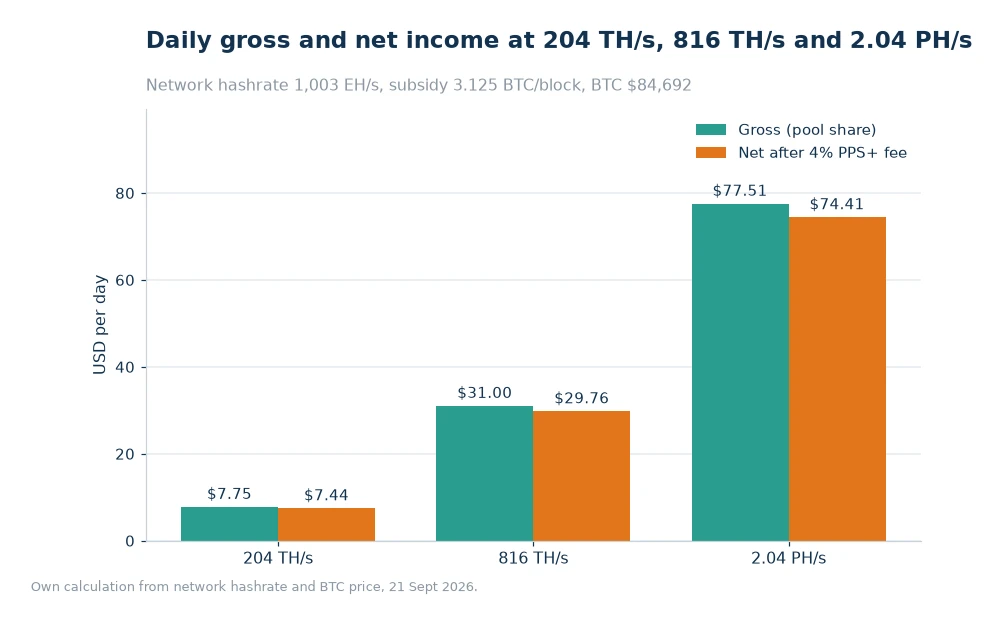
The number that matters is the one that lands in the wallet, and it is smaller than the number on the hashrate chart. At 204 TH/s the gross credit is $7.75 a day and the net is $7.44; at 2.04 PH/s the same pair reads $77.51 and $74.41. The gap looks trivial until a power bill arrives and the margin turns out to be the difference.

Key takeaways
- 204 TH/s earns 0.000091525 BTC a day, or $7.75 gross and $7.44 net at these inputs.
- 816 TH/s is exactly four times that, and 2.04 PH/s is ten times it.
- Net arrives after the listed 4% on the PPS-settled block reward, which costs $0.31 a day at 204 TH/s.
- Power is the line that decides whether $7.44 is a margin or a loss.
A ladder built on one number
Mining arithmetic at this scale is multiplication all the way up. One terahash earns 0.00000044865 BTC a day at a 1,003 EH/s network with 450 BTC issued daily. Multiply by 204 and the credit is 0.000091525 BTC; multiply by 816 and it is four times that; multiply by 2,040 and it is ten times. Nothing about the pool or the coin changes between the rungs.
That linearity is a convenience and a trap. It is convenient because a single spreadsheet row can be scaled to any size in seconds. It is a trap because the costs do not scale in the same tidy way: a fourfold increase in hashrate usually means four machines, four power supplies, more heat in the same room and a higher chance that one of them is the one that fails this month.
From hash to wallet in four steps
Shares are submitted, difficulty converts them into an expected block reward, the pool aggregates the group's blocks, and settlement credits the account. Under PPS+, the block-reward component is settled hourly against current difficulty, so the wallet sees a series of small credits rather than a lump when a block lands. The miner's exposure to pool luck and orphan risk on that component is removed, which is reflected in the listed 4%.
The transaction-fee component follows a different rule with a listed 2%, and under PPLNS the combined reward and fees settle after six confirmations over the last five difficulty rounds. The four steps are the same in every mode; what changes is when the credit appears and who carries the variance while waiting.
Three rungs, one table
Net applies the listed 4% to the block-reward component, which dominates the credit at these hashrates. Values use BTC at $84,692.
| Hashrate | Daily BTC | Gross USD/day | Net USD/day |
|---|---|---|---|
| 204 TH/s | 0.000091525 | $7.75 | $7.44 |
| 816 TH/s | 0.00036610 | $31.00 | $29.76 |
| 2.04 PH/s | 0.00091525 | $77.51 | $74.41 |
The middle rung is where most small farms sit: four machines, one power feed, one network link. The top rung is a different kind of operation, with three-phase power and someone on call. The arithmetic does not distinguish between them, which is why the operational differences have to be added by hand.
Worked example
Build the 204 TH/s row from the network, then check the ladder.
- 450 BTC a day ÷ 1,003,000,000 TH/s = 0.00000044865 BTC per TH/s per day.
- 204 TH/s × 0.00000044865 = 0.000091525 BTC a day.
- 0.000091525 × 84,692 = $7.751, rounded to $7.75.
- 4% of $7.75 is $0.31, so net is $7.44.
- 816 TH/s is 4 × 204: 4 × 0.000091525 = 0.0003661 BTC, and 0.0003661 × 84,692 = $31.00.
- 2.04 PH/s is 10 × 204: 10 × 0.000091525 = 0.00091525 BTC, and 0.00091525 × 84,692 = $77.51.
- Net at 2.04 PH/s: $77.51 × 0.96 = $74.41.
- Thirty days at 204 TH/s: 30 × 0.000091525 = 0.00274575 BTC, or $232.54 gross and $223.24 net.
What the net figure has to cover
At 204 TH/s, a machine drawing about 3.2 kW at $0.07 per kWh spends $5.38 a day. Against $7.44 net, that leaves about $2.06. The margin is real and it is thin, and it is the reason power rate is the first question in mining rather than the last. At $0.10 per kWh the same draw costs $7.68 and the margin is gone.
The fourfold and tenfold rungs do not escape the problem. Four machines draw four times the power in a month with four times the chance of a repair. The net per terahash is identical, so scaling up multiplies both the margin and the exposure. A miner who is uncomfortable with the exposure should fix the power rate before adding hardware, not after.
Moving coin out of the account
Settlement credits the pool account, and the multi-currency wallet inside the same login is where those credits sit until moved. Zero-fee mining payouts mean the withdrawal itself carries no pool fee, which matters most at the small end: at 204 TH/s the daily net is $7.44, and a fixed withdrawal fee would consume a visible share of a weekly transfer.
Auto Conversion handles the case where the coin credited is not the coin needed. A miner paying a bill in one currency and credited in another can convert inside the account rather than sending coin out and back, which removes a step and a chain fee. It does not change the arithmetic above; it changes how much of the arithmetic survives the trip.
Watch the right number each week
Three figures are worth a weekly look: reported hashrate, credited balance and power draw. If the first falls, the second follows within a day or two. If the third rises while the first holds, efficiency has slipped, usually through heat or a failing fan. Comparing the pair against the table at the top of this article tells you whether the machine is performing to its rating.
The ViaBTC App puts the hashrate curve and the balance on one screen, which is enough for that weekly check without opening a laptop. The ViaBTC Bitcoin Mining account behind it holds the payout address, so a change of wallet is a settings edit rather than a migration.
Choosing a rung on purpose
Most miners drift upward one machine at a time and discover the operating cost after the third. A better method is to pick the rung deliberately: write the net daily figure, subtract the power cost at the site's real rate, and decide whether the remainder justifies the capital and the attention. That calculation takes ten minutes and prevents most of the regret in this business.
If the answer is no at 204 TH/s, it will not become yes at 2.04 PH/s without a change to the power rate or the hardware generation. Scaling a losing operation multiplies the loss, and the table makes that visible before the purchase rather than after it.
Frequently asked questions
How much does 204 TH/s earn per day?
About $7.75 gross and $7.44 net at a 1,003 EH/s network and BTC $84,692, which is 0.000091525 BTC a day before the listed 4% on the block-reward component.
Is 2.04 PH/s just ten times the income?
In the arithmetic, yes: ten times the hashrate means ten times the BTC and dollars. In practice it also means ten machines, ten power supplies and a much larger monthly power bill, so the net margin per terahash stays the same while the exposure grows.
When do the credits actually arrive?
Under PPS+ the block-reward component settles hourly against current difficulty, so credits appear through the day; under PPLNS the combined reward and fees settle after six confirmations.
Decide with the net column
Take the net figure for the rung you are considering, subtract the daily power cost at your site, and look at what is left. If that number is small enough to be erased by a difficulty change, the rung is too high for the margin or the power rate is too high for the rung. Both are answerable before any hardware is ordered.
The multi-currency wallet shows what actually arrived over the last month, and the Profit Calculator rebuilds the projection from current inputs. A monthly comparison of the two is the simplest audit a small mining operation can run, and it catches most problems while they are still cheap.
Sources: the ViaBTC homepage, wallet and calculator pages, with chain data read 21 Sept 2026[1]. Network hashrate 1,003 EH/s, difficulty 132.76 T, 3.125 BTC per block, 144 blocks a day, BTC $84,692. Published 22 Oct 2026; figures assume continuous uptime and a steady difficulty.