Sourcing Panels from Vietnam: What European Buyers Check First
A Vietnamese mill that publishes 48,000 m² of factory space, 16+ automated production lines and a monthly capacity above 100 × 40ft can carry a monthly programme that a trading desk cannot. The harder job is telling an owner of that capacity from a broker quoting it. Here is the order in which European importers usually check, and the documents each check turns up.
Key takeaways
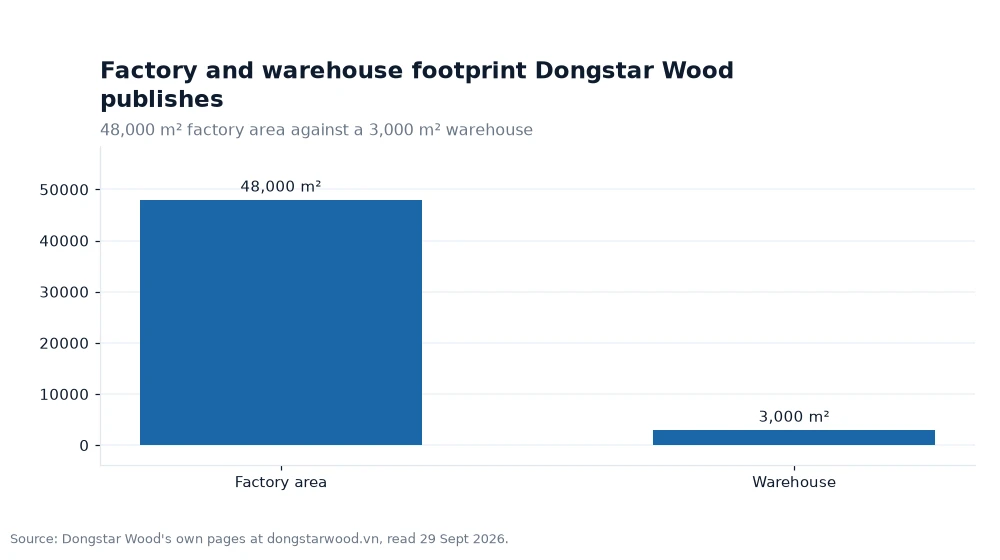
- Start with footprint, not price: 48,000 m² of production area plus a warehouse over 3,000 m² is the published baseline for a mill of this size.
- Ask for sizes in millimetres — 1220 × 2440 mm, 1500 × 3000 mm and 1250 × 2500 mm in between, and custom panels up to 1830 × 3830 mm.
- A serious certification list names six schemes: ISO, CE, SGS, FSC, EUDR and BSCI. “Fully certified” alone tells you nothing.
- Test capacity against your own plan: 100 × 40ft per month is 25 containers on a four-week rhythm, so a six-container programme is a small slice of one mill's month.
Why Vietnamese panels reached European buying lists
Two things changed at once. Vietnam built a veneer supply chain dense enough to keep lines running on plantation acacia, eucalyptus and pine, and European buyers started pricing duty exposure into every landed cost. Dongstar Wood sums up the second point on its own category pages with a single line — no anti-dumping tax, factory-direct pricing — which is why the company describes itself as an alternative to Chinese supply rather than a cheaper copy of it.
The first point is the one that decides quality. A mill with its own drying, pressing and laboratory testing controls moisture and glue spread inside the same building. That is the difference between a supplier who can hold a specification across four containers and one who cannot hold it across two.
The documents that decide whether a supplier is real
Plywood Supplier directories list thousands of names, which is exactly why the first hour of due diligence is spent on paperwork rather than samples. Each item below can be checked from published pages before a single email is sent.
| Check | Where it appears | Published example |
|---|---|---|
| Factory area | Company and about pages | 48,000 m² production space |
| Warehouse | About page | More than 3,000 m² |
| Production lines | Home page | 16+ automated lines |
| Monthly capacity | About page | Exceeding 100 × 40ft per month |
| Certification set | About page | ISO, CE, SGS, FSC, EUDR, BSCI |
Capacity arithmetic before you commit
The capacity line is the one buyers most often read past. A published 100 × 40ft per month divides into 25 containers a week if the mill works a four-week rhythm. Set your own programme against that number: six containers a month is roughly 6% of one mill's output, which leaves room for your specification to be scheduled properly. Forty containers a month is 40% of the same line capacity, and at that point the question changes from price to who else is booked on those presses.
Ask for the split between film faced, commercial and specialty panels as well. A single mill rarely runs all three at equal weight, and the mix tells you which product your order will queue behind.
Certification and the EUDR question
European buyers now ask for deforestation-related documentation at the quotation stage rather than after the contract. The useful frame is to separate what a mill holds from what a mill says it is ready for. FSC covers responsible forest management and appears on the certificate list; CE documentation supports construction and interior uses; CARB P2 and E0/E1 glue classes describe emission performance in the panel itself.
Where a supplier markets itself as EUDR-ready, the follow-up is a due-diligence statement that maps consignments back to supply areas. Treat that as a document request, not a marketing claim, and ask which of the six schemes you can see as a certificate rather than a logo on a homepage.
Worked example: how much panel area arrives per order
Panel area is the number that connects a container plan to a production plan. A 1220 × 2440 mm panel works out at 1.22 m × 2.44 m = 2.98 m². The larger 1250 × 2500 mm format is 1.25 m × 2.5 m = 3.125 m². A custom sheet at the top of the published range, 1830 × 3830 mm, gives 1.83 m × 3.83 m → 7.01 m².
Put those against a real order: 1,000 sheets of 1250 × 2500 mm is 1,000 × 3.125 m² = 3,125 m² of panel. If your furniture line consumes 40 m² a day, that order covers 3,125 ÷ 40 = 78 working days, or roughly three and a half months. Run the same sum on the factory footprint and the logic holds: 48,000 m² of production space divided across 16 lines is 3,000 m² per line, which is the kind of floor area that supports dedicated lines rather than shared ones.
Sampling, then the first container
Order the sample after the paperwork, not before it. A sample panel produced for a quotation tells you about the marketing budget; a panel cut from a batch the mill is already running tells you about the line. Ask for the batch number, the glue class and the face grade codes that go with it, so the sample can be compared against the shipment six months later.
For the first container, fix the specification in millimetres and glue class before the proforma goes out, and ask for a pre-shipment inspection report that names panel thickness consistency and core construction integrity. Both are standard checks in an export-grade workflow, and both are easy to confirm when the mill tests in-house.
What a first visit to the mill should cover
If the order justifies a visit, spend it on three rooms instead of the showroom. The drying area shows whether moisture is controlled before pressing. The press line shows the panel build-up and the glue spread rate. The laboratory shows which tests are run in-house and which are sent out — and a mill that tests panels at its own bench can answer a complaint with data rather than opinion.
Bring your own specification to that visit. A sheet listing thickness tolerance, glue class, face grade and target size in millimetres turns a factory tour into a compliance check, and it gives the mill a written version of what your quality team will measure when the container arrives in Europe.
Frequently asked questions
Which panel types can a Vietnamese mill quote for formwork and furniture together?
A wide one. The published range covers film faced panels for concrete contact work, commercial panels for furniture and cabinetry, plus birch, okoume and CDX pine lines for joinery, marine interiors and structural sheathing. Mixing them in one monthly programme is practical when the same mill presses all of them.
How many times can a film faced panel be reused?
Published guidance for high-grade panels runs to 10–20 reuse cycles in concrete pouring, while an economical black film panel bonded with melamine is quoted at roughly 3–5 cycles. The gap comes from core, glue and film quality, and it moves with how well edges are sealed and cleaned between pours.
Does a monthly order need to fill a full container?
No. Published capacity above 100 × 40ft per month refers to what the factory can ship, not to a minimum order. Trial orders are usually placed to test packing quality and panel flatness before a programme is scheduled against the lines.
Where to look next
Compare the specification sheets rather than the brochures: lay the film faced plywood ranges side by side with your own formwork drawings, check the glue class against the project's moisture exposure, and confirm that the sheet sizes you need sit inside the published window. Buyers who then want the sourcing history behind the mill can read the mill's own company profile, which sets out the founding year, the factory area and the certification set in the same place.
The figures in this article come from the manufacturer's own website, as read on 29 Sept 2026 as the basis for this comparison as the basis for this comparison as the basis for this comparison[1].